Beemail

-
The Green Queen 🟩👑
Hi everyone,
I inspected both hives on Sunday. Hive B was doing very well. They have a lot of honey already and are starting to expand into the additional box I installed last time. And I spotted the queen that we marked a few months ago with a green dot. She seems to be doing well.
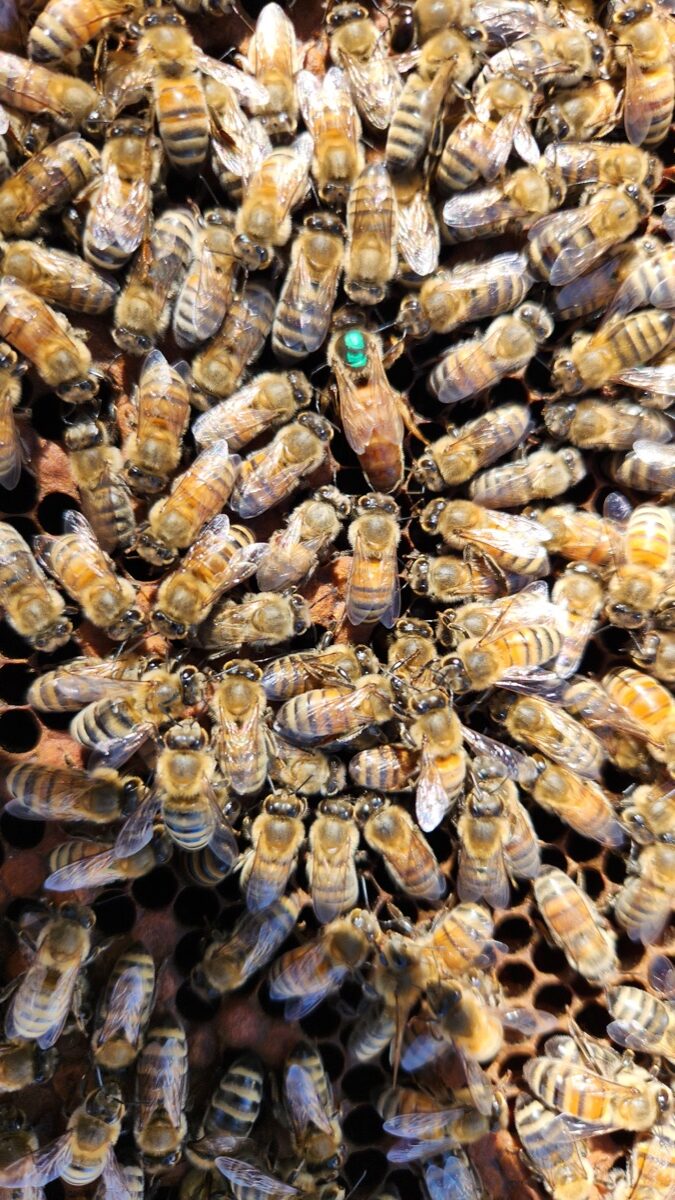
Hive A (the one that is still rebounding) is showing improvement. The population is stronger and I did observe baby bees at multiple stages (larvae and pupae). I did not see the queen, but given the presence of some young larvae, I can assume that she was there recently. Bee-Mentor Steve said I should quit worrying but suggested that I put out some sugar water for them.
My video editor put together a nice little montage from some clips from the last few months. The other person in the video is Steve, who came out to help me a few times.
Video: https://photos.app.goo.gl/A7KsJ4D5UpF6XEQn9
Stay buzzy!
-
The Switcheroo
Hi everyone,
Time for another bee update. And sorry in advance, I didn’t get a chance to get any good pictures.
I did an inspection on May 10. Hive A (the one that had to re-queen itself) was sparsely populated. There were no longer any queen cells, so this most likely means that one emerged and took out the competition. I did not see any eggs or larvae and I was about to give up on finding the queen, but there she was on the last frame. I went to get the camera and when I came back, I couldn’t find her again. Bee Mentor Steve (hereafter, “Steve”) said that she might not have been on a mating flight yet (the weather hadn’t been great).
On May 15, I found Hive A again very sparsely populated, and yet I still couldn’t spot the queen. But I did see young larvae (so about 3-4 days old) and some capped brood (they cap the larva cells when they start to pupate at day 9). This suggests that the queen was there and laying. Steve said, “don’t worry, give it time” (this will become a recurring theme).
As for Hive B (the very active one), on May 10, there was a lot of activity. Lots of honey, lots of young larvae and capped brood. I couldn’t spot the queen, even though we had marked her previously with a paint marker, but there’s good evidence that she was there. I noticed a lot of “bearding” (when a lot of bees congregate and hang from the underside of the entrance, making a “beard” formation). This could be due to the heat or due to overcrowding.
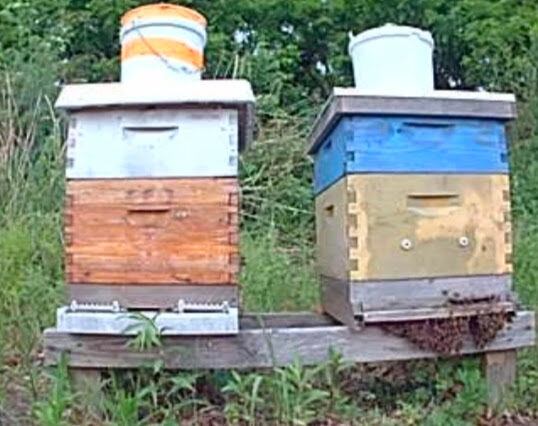
I asked Steve for advice and his answer was, of course, “don’t worry, give it time.” There is some new brood, so I am hopeful that the population starts to rebound in the next week or so as some of that brood emerges.
Steve: “You could also swap the hives?”
Me: “Swap the hives? You mean physically swap their positions? How will that help?”
Steve: “It’s a quick way to add some extra resources and population to the weaker hive.”
Apparently, if you pull the switcheroo during foraging hours, the foragers will come back to exactly the same spot they left from, seemingly unfazed by the fact that there is a different hive there.
I imagine the conversation goes something like this:
Forager 1: “Hey, does this look a little different to you? I remember there being more bees here.”
Forager 2: “Listen, sister, they don’t pay us enough to think. The work order says to drop off the pollen at the hive on the left. Let’s unload it and go on break.”
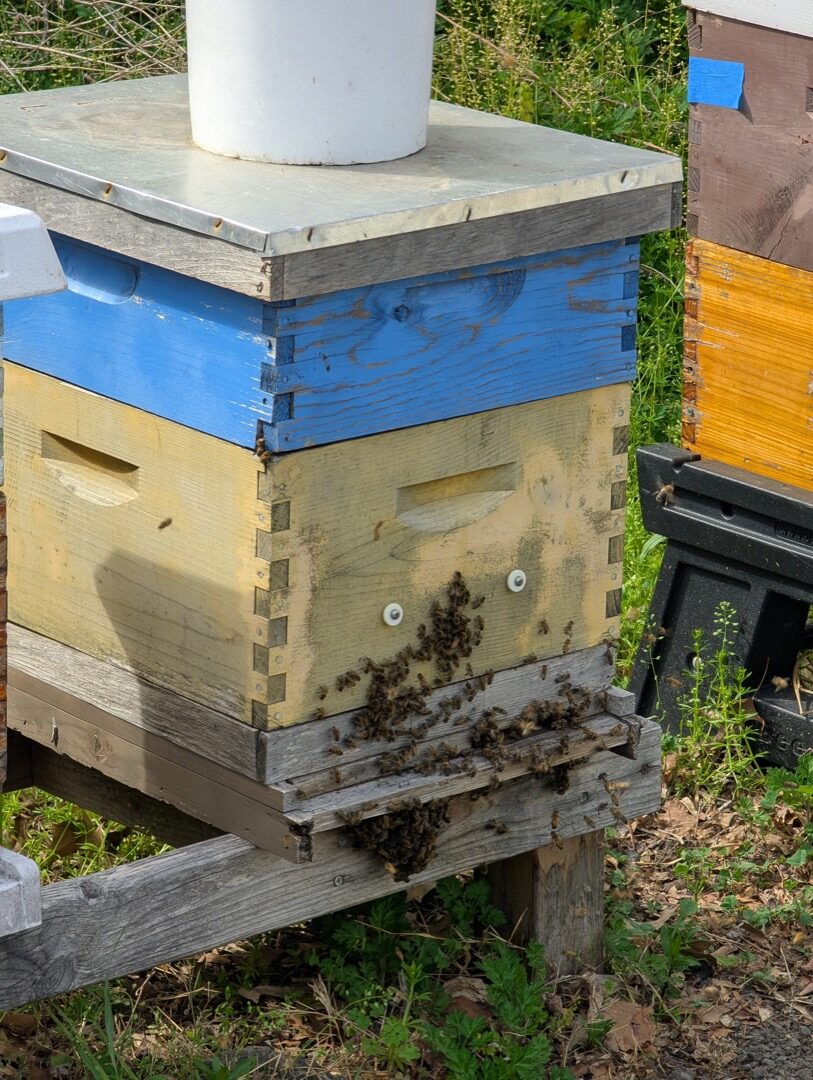
So I have switched positions, and also labeled the hives better. I also added another super (a box above the brood box) with 10 empty frames, so this should address overcrowding. Or it could be too late and they could be preparing to swarm. I did not have time to fully inspect and look for new queen cells (a clear sign that they are preparing to swarm and have a new queen lined up to take over).
The photo above is the “before.” The photo below is the “after.”
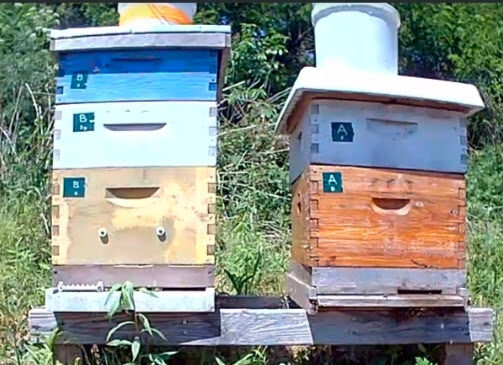
As you can see, they are now labeled, with Hive B on the left and Hive A on the right, and Hive B now has an additional “expansion pack.”
In the process of switching the hives, I accidentally knocked over Hive A (sorry, ladies!) but the bees seemed no worse for the wear (although I’m sure they didn’t like their house tumbling to the ground, upside down, like a huge earthquake). I hope I didn’t hurt the queen. When they fell, one of the boxes got out of square a bit. In true CERT spirit, I will repair this with duct tape to close up the gaps until I get a chance to swap out that box and move the frames into a new one.
That’s all for today.
-
Water Features and Queen Cells
Hello again, and sorry for the long delay.
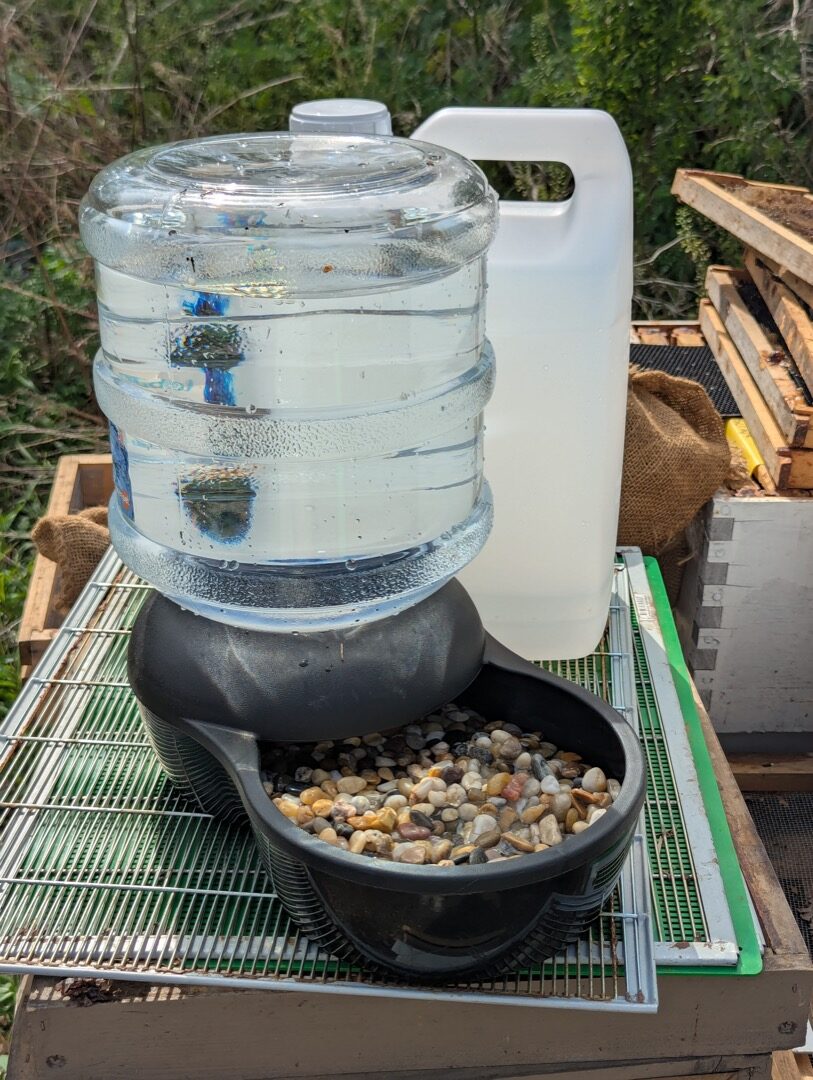
On April 18, I installed a new water feature. Bees like water, but they don’t like swimming, so I put some pebbles inside so they have something to stand on. I invented this myself. Not the concept, but the execution.
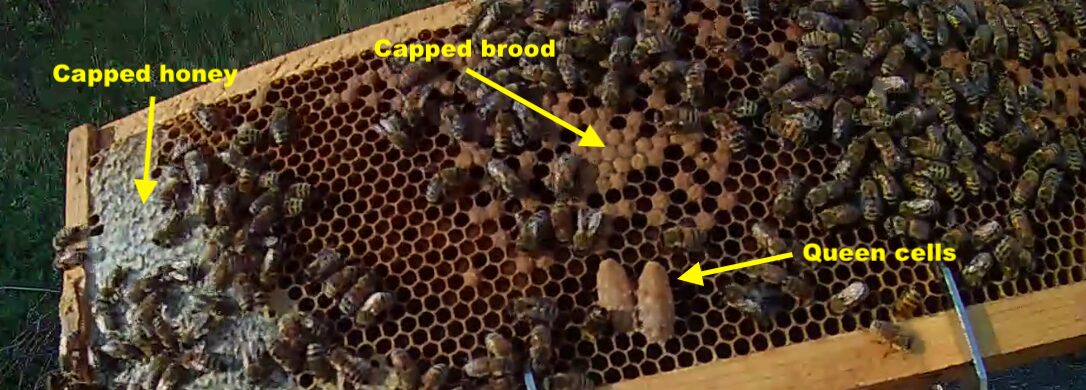
I also inspected Hive 490A (the one that needs a new queen). I’m not an expert here, but I saw some good signs. I found 4 queen-size cells that were capped with wax. This means, I hope, that there were new enough eggs (within 3 days of being laid by the old queen) to start making a new queen. After 3 days, the egg hatches and the nurse bees feed it a diet of only royal jelly. This is what causes it to grow into a queen. Four seems about right. The colony hedges its bets. A queen takes 16 days to emerge. Whichever one emerges first will take out the competition. I haven’t been able to go back and check since it has been too cold on the days I was free. Bee-Mentor Steve says, “now we wait.” I will keep you posted!
The ladies of Hive 490B were quite active (that’s the one that kept the queen).
On April 23, I collected 17 frames of honey from the absconded hive. Nobody from the bee club has had time to help me with the extraction yet, so these frames are currently in a big freezer at Fire Station 22.
My video editor is working on a montage of some clips I recorded last time, plus a few from the BeeCam. Apologies for the quality. I have a knock-off GoPro and it was hard to keep it clipped to my suit. I have a tripod for next time. Here are some of the raw clips:
- https://drive.google.com/file/d/1izsZaabZEgI21WTdI9zm0FMFJ8PkcqS4/view?usp=sharing
- https://drive.google.com/file/d/18i7orHYLnYE6CY2jwuslkcv4HYaI7WK9/view?usp=sharing
- https://drive.google.com/file/d/1GtEwrLdslOMLufhgqz7VTXFUSoNiNkoP/view?usp=sharing
- https://drive.google.com/file/d/1p4UwmG4FZfu2DWgQrxKlmKErYPThyTiK/view?usp=sharing
- https://drive.google.com/file/d/1lt-rNmnL02MXMOICPbAIc949LwAiFW4f/view?usp=sharing
- https://drive.google.com/file/d/1HsBbnym4V7fLBcmypNLvHe9aILV4G3N-/view?usp=sharing
- https://drive.google.com/file/d/1DGEAMFxTAAFjuNkyjLflA2vAkhTc9eaY/view?usp=sharing
- https://drive.google.com/file/d/1kCmX8SmceKX5UdVcWkguVC9TSDmHworn/view?usp=sharing
- https://drive.google.com/file/d/1XZ8S0AFz-HYgZA0af5MexA6LL_7g8PHX/view?usp=sharing
- https://drive.google.com/file/d/1nmp7Jj6ij9puX1llRo-vz3dOKHV5DG5G/view?usp=sharing
- https://drive.google.com/file/d/1GST5Rs13yoO-KrfuV7hKB35BMRiAk_gC/view?usp=sharing
- https://drive.google.com/file/d/1-hl81GIORbnufrj-Zmtq9r2RBcmFeFfA/view?usp=sharing
- https://drive.google.com/file/d/1t3mfq-_A9XxxtB9cZJonVucuJz_2JkPR/view?usp=sharing
- https://drive.google.com/file/d/1OO893uk4jawszwhjhbG3CodFYAHXTusZ/view?usp=sharing
In some of them, I am inspecting the top box (“super”), which is mainly for honey storage. In a few, you can see the queen cells. They are built perpendicular to the regular comb and look kind of like peanuts. I don’t know why they put the queen cells in the super. In some of the other clips, I am finishing the inspection of the lower box (“brood box”), which is normally where the baby bees are. The workers cap the cells with wax to keep the honey inside or to protect the developing bees. The cell is kept open when the bee is a larva so it can be fed. When it becomes a pupa, the cell gets capped. Bees metamorphose like butterflies and then chew open the cap and emerge in adult form.
🐝🐝🐝
-
Why is it called HIVE 490?
HIVE 490 is situated at the top of “Mt. Trashmore,” the Fairfax County I-66 Solid Waste Transfer Station. It sits on a small parcel assigned to CERT, by way of the Fairfax County Fire & Rescue Deparment, CERT’s sponsoring agency.
I have been active in CERT for several years, and when the previous beekeper (our CERT program manager) retired and moved away, he offered me the opportunity to take over the hives.
Every fire station in Fairfax County is assigned a three digit number (and they all begin with 4, which distinguishes Fairfax’s Station 15, from, for example, Loudoun County’s Station 15, which is 615).
When CERT began providing canteen support, we needed an identifier assigned to our apparatus, so the FRD gave us “station” number 90. Hence, our canteen is “CAN490.” Since the hives are located at our “station,” I thought it would be fun to call them “HIVE 490.”
You may also see me refer to the individual hives as “HIVE 490A” or “HIVE 490B.” This is also FRD naming convention. If a station has more than one apparatus of a particular type (e.g., engine, truck, canteen), the additional ones are labeled “Bravo,” “Charlie,” etc. Usually Alpha is not specifically labeled, but I’m doing it here for clarity. So the apiary is called “HIVE 490” and the two hives are Alpha and Bravo.
PLEASE NOTE: HIVE 490 and hive490.buzz are not affiliated with or paid for by Fairfax County CERT, the Fairfax CERT Association, or the Fairfax County Fire & Rescue Department. The parcel is a convenient place to keep the hives, and I am grateful for my hives to be able to call this small patch home.
-
Welcome to Beemail
Welcome to Beemail, the (very) occasional newsletter from HIVE 490 at Mt. Trashmore. This is where I’ll post updates on the hives — inspections, splits, swarms, honey harvests, winter prep, and whatever else comes up over the course of a season.
A few notes on what to expect:
- Frequency: roughly once a month, usually tied to something actually happening at the hives.
- Format: usually short updates.
- Where it lives: every update is posted here first, and also goes out by email to subscribers.
If you’d like future updates delivered to your inbox, use the Subscribe link at the top of the page. Thanks for reading!